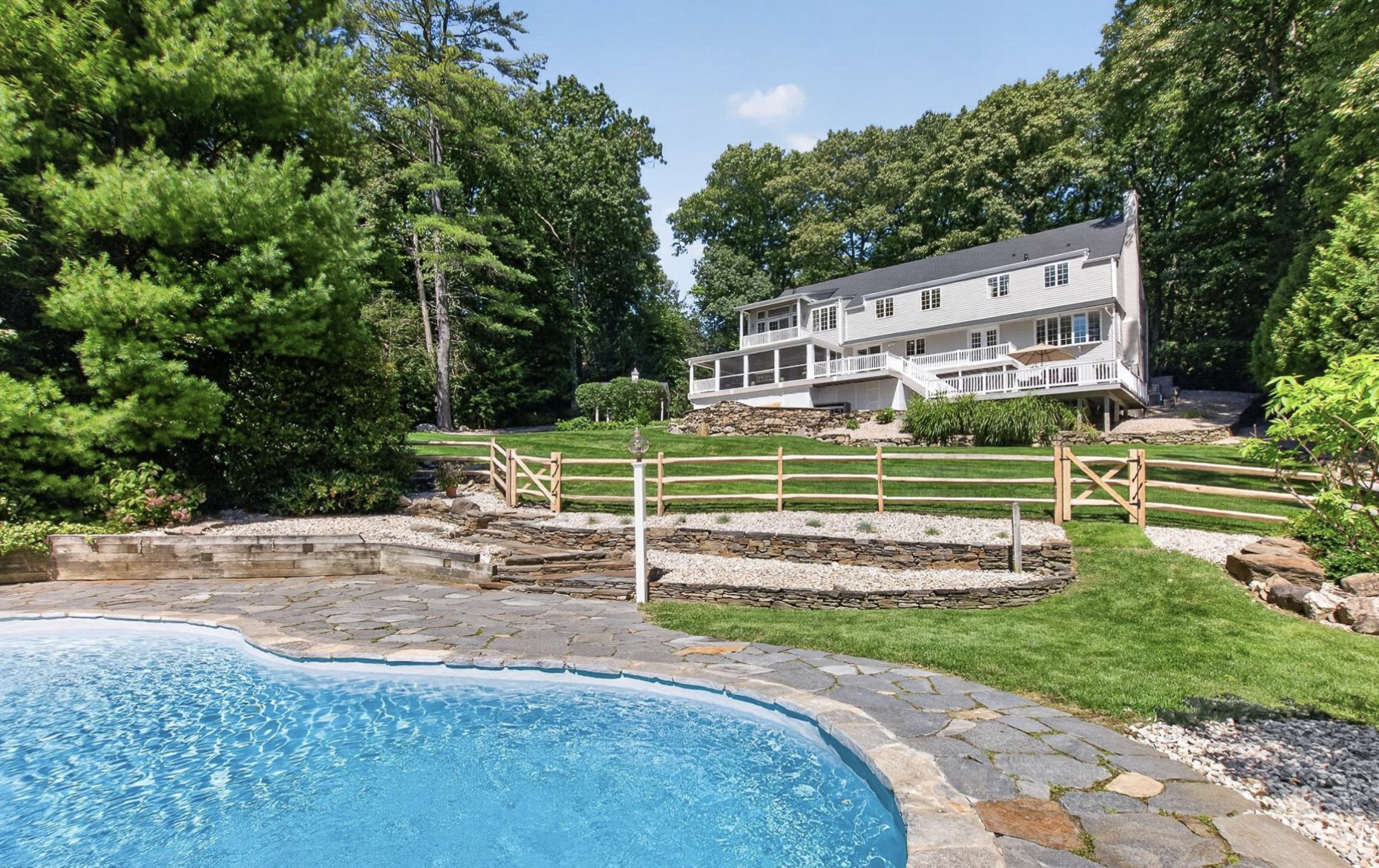
A 6 bedroom Simsbury home listed by Julie Sirois of Berkshire Hathaway, currently under contract
Simsbury CT Homes With a Pool or Guest House:
Permits, Taxes, and What Buyers and Sellers Should Check

Quick Answer
- Simsbury regulates accessory apartments and guest units under Section 3.5, citing a limit of 600 square feet or 30 percent of the home and an owner who lives on site. Confirm the current rules and approval path before you buy or build.
- Buyers should pull permit records and confirm final inspections. Sellers should close open permits before listing.
A pool, a guest suite, or an in-law apartment is a selling point at the $900,000 level and above, and it is also a source of paperwork. In Simsbury, each one raises the same questions: was it permitted, is it legal as built, how does it change the tax bill, and how will an appraiser treat it?
This guide covers what to confirm on a home with a pool, how Simsbury's accessory apartment rules work, what a new addition does to the assessment, and what buyers and sellers should do before a contract deadline. It relies on town documents and state sources, and it flags what I could not verify.
Buying a Home With a Pool
A pool adds a structure, equipment, and a seasonal system to inspect. Start with the town record. The Building Department states that all permits must receive at least a final inspection, so ask for the permit history and look for any permit that was opened and never closed. Call the department at 860-658-3235, or use its Building Department page, to confirm current permit and barrier requirements for pools. I did not find a Simsbury pool rule to quote, so do not rely on a summary from anyone, including me.
- Permits and final inspections. Request the record for the pool, decking, fencing, and electrical work.
- Survey. Confirm the pool and any fencing sit inside the boundary and that the survey shows them.
- Septic and well. Ask where the pool, equipment, and drainage sit relative to the septic system and well, and who approved the layout.
- Equipment and structure. Have a pool professional review the liner or shell, pump, heater, cover, and decking, and ask for service records.
- Season. In the colder months the pool may be closed, so ask for photos of it open and records of its last season.
- Insurance. Ask your insurance agent how a pool affects the homeowner's quote before you remove contingencies.
Guest House or Accessory Apartment: What Simsbury Allows
The word "guest house" does not appear in the rules I found. Simsbury regulates accessory dwelling units under Section 3.5. Zoning Commission staff reports from 2022 to 2024 (see also a 2022 report) cite Section 3.5.2(A) for attached units, and describe these requirements:
| Requirement | What the Staff Reports Cite |
|---|---|
| Approval (2022 to 2024 reports) | One unit within the footprint of the primary structure, permitted by site plan, plus an administrative zoning permit for construction. The Commission revised the review process in February 2025, so confirm the current path. |
| Size | Up to 600 square feet or 30 percent of the primary dwelling's gross floor area, whichever is greater |
| Occupancy | The owner of record must live in either the unit or the main house, with an owner affidavit |
| Parking | At least one dedicated off-street space with a solid surface, and no new curb cut for the unit |
| Number | One accessory dwelling unit per lot |
| Codes and health review | Building, health, and fire codes apply, and the Farmington Valley Health District reviews septic when an added bedroom requires it |
Simsbury's Zoning Commission also approved opting out of the accessory dwelling and parking provisions of Public Act 21-29 on January 3, 2022, so the town's own rules govern, not the state's. The reports I reviewed cover attached units. The Zoning Commission's February 3, 2025 action amended Section 3.5 to revise the review and approval process for both attached and detached accessory dwelling units, according to the town's notice. A detached guest house is therefore regulated as an accessory dwelling unit, not a gray area, but the exact approval path, size, parking, and septic or health conditions for a detached structure should be confirmed against the current Section 3.5 text and the specific parcel. Ask the Planning Department how your structure would be classified before you assume it is legal or can be built.
The size limit scales with the house, as the chart shows. The owner-occupancy rule matters to both sides: it shapes who can live in the unit and how a buyer may use it.
Maximum Attached Unit Size Under the 600 Sq. Ft. or 30% Rule
Calculated as the greater of 600 square feet or 30 percent of the primary dwelling's gross floor area, as cited in Simsbury Zoning Commission staff reports for attached units. The primary home sizes shown are hypothetical examples. Confirm limits for a specific property with the Planning Department.
What a Pool or Addition Does to the Tax Bill
Property tax is calculated from the parcel's taxable assessed value, not automatically from its purchase price. For FY 2026-2027, Simsbury's combined town and fire-district rate is 35.00 mills (33.67 town plus 1.33 fire district), per the town's mill rate history. Connecticut assessors value property as of October 1, and under state law partially completed construction can be taxed on its October 1 value, with a supplemental prorated bill when work is finished, according to a law firm summary of the statute. That article dates from 2012, so confirm the current rule with the assessor.
As an illustration, if a pool or addition raised a home's market value by $100,000 and the assessor taxed it at 70 percent, the added tax would be about $2,450 a year at the combined 35.00 mill rate. The real figure depends on how the assessor values the work. Ask the assessor how a specific project, or an existing pool you are buying, is carried on the record. Our Simsbury property tax guide for out-of-state buyers covers the basics.
Appraisal and Value
Appraisers rely on comparable sales, and a home with a pool, a guest suite, or an unusual layout often has few close comparables. That can leave a gap between what a buyer is willing to pay and what an appraiser supports. I am not quoting a dollar premium for a pool or guest space, because I did not find a verified Simsbury figure.
Two practical points follow. Space that was built without permits may not be counted the way finished, permitted space is, so ask the buyer's lender and an appraiser how they will treat it. And talk to a lender early about how the property will be evaluated, as covered in our Simsbury luxury homes guide.
Buyer's Checklist
- Permit record. Get the town's permit history for the pool, additions, finished spaces, and any apartment, and confirm final inspections.
- Zoning status. Ask the Planning Department whether any unit or in-law space is recognized, and what conditions apply.
- Owner-occupancy. If a unit exists, understand the owner affidavit and the occupancy rule before you plan to rent or host.
- Tax record. Ask the assessor how the pool and any additions are carried and what the current bill is.
- Inspections. Add pool equipment, septic capacity for the bedroom count, and structural review of additions.
- Insurance and lender. Get quotes and ask how the lender will treat unusual or unpermitted space.
- Flood and renovation limits. Near the river, review the renovation rules in Simsbury CT Homes Near the Farmington River.
Coordinate these checks with your attorney and schedule them within the inspection and due-diligence deadlines written into your purchase contract. Confirm that the contract provides enough time to obtain permit records and complete inspections. The full sequence is in How to Buy in the Farmington Valley.
Seller's Checklist
- Permit file. Pull the town record for every pool, deck, addition, and finished space, and close any open permit with a final inspection.
- Unpermitted work. Talk to your attorney and agent about disclosure and cleanup before you list.
- Survey and documents. Provide a survey that shows the pool and fencing, septic records, and any owner affidavit or approvals for an accessory unit.
- Pool records. Gather service history, equipment age, and photos of the pool open.
- Pricing. Price from closed sales and documented condition, as covered in How to Price a Home in the Farmington Valley, and plan the timeline with Selling in the Farmington Valley.
Buyers who see a clean permit file move ahead with confidence. Buyers who find a gap late negotiate or walk away. For larger properties, see also Simsbury CT Homes With Acreage and the historic homes guide.
Buyer's rule: Treat every pool, addition, and guest space as a question for the town record. Get the permits, confirm the final inspections, ask what the assessor carries, and ask the lender how it will count the space before your contract deadlines pass.
Looking at a home with a finished basement or an addition? See Simsbury CT Homes With Finished Basements, Additions, and Permit Questions for the records to pull.
Buying or selling a Simsbury home with a pool, guest suite, or accessory apartment? A direct conversation about the permits, the numbers, and your timeline saves time and surprises.
Submit a private inquiry or reach me directly:
412-225-0598 · PeterTumbas@bhhsne.com
Frequently Asked Questions
Do I need a permit to build a swimming pool in Simsbury CT?
Plan on it. The town reviews pool construction, and the Building Department says every permit must receive at least a final inspection. Call the department at 860-658-3235 for current permit and barrier requirements before you hire a contractor. See the Building Department page.
Can I build a guest house or in-law apartment in Simsbury CT?
Probably, with conditions. Simsbury regulates accessory dwelling units under Section 3.5, and the Zoning Commission's February 3, 2025 action revised the review and approval process for both attached and detached units, according to the town notice. Detached units appear to fall under the same provisions, but confirm the current Section 3.5 text, the approval path, and any parking or septic conditions for your parcel with the Planning Department. Earlier staff reports describe attached units permitted by site plan.
How big can an accessory apartment be in Simsbury CT?
For an attached unit, staff reports cite a limit of 600 square feet or 30 percent of the primary dwelling's gross floor area, whichever is greater. A 5,000 square foot home could therefore have a unit up to 1,500 square feet, and a 1,500 square foot home is capped at 600. Confirm the current limit, and the limit for a detached unit, with the Planning Department.
Does Simsbury follow the state accessory dwelling unit law?
Simsbury's Zoning Commission approved opting out of the accessory dwelling and parking provisions of Public Act 21-29 on January 3, 2022, so the town's own accessory apartment rules govern, and the town revised them again in 2025. Staff reports cite one unit per lot and a requirement that the owner live in either the main house or the unit.
How does adding a pool or guest house affect Simsbury property taxes?
Connecticut assessors value property as of October 1, and completed or partially completed construction can add to the assessment, sometimes through a supplemental prorated bill. At 35.00 mills (Simsbury's combined town and fire-district rate) and a 70 percent assessment ratio, each $100,000 of added market value adds about $2,450 a year. Ask the Simsbury assessor how a specific project would be valued.
What should I do about unpermitted work before selling a Simsbury home?
Ask the Building Department for the permit record, close any open permits with a final inspection, and talk to your attorney and agent about disclosure before you list. Unpermitted space can raise questions with buyers, appraisers, and lenders, so address it before you go to market.